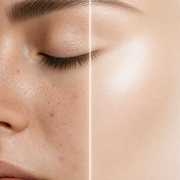
Why your skin looks different in every selfie
If one selfie makes your skin look smooth and the next makes it look tired, that usually says more about geometry and lighting than about overnight skin change.

GlowKit's angle: one dramatic selfie is not a verdict. Consistent capture conditions are more useful than chasing the most flattering or most alarming frame. GlowKit is for cosmetic observation and progress tracking only, not diagnosis or treatment.
On this page
People often assume their skin is unpredictable because one front-camera photo makes them look glowy and another makes them look uneven, red, or tired. Usually, three variables moved at the same time: camera distance, camera angle, and lighting. Your own familiarity with the mirror version of your face adds a fourth layer.
This guide is for general cosmetic and wellness decision-making only. If you are worried about a rash, swelling, pain, or a persistent skin change, stop relying on selfies and speak with a qualified clinician.
Three things are changing at once
Skin rarely changes meaningfully from one hour to the next, but photos do. A closer camera can exaggerate proportions. A slightly higher or lower angle can emphasize shadows under the eyes, around the nose, or along texture. Warmer indoor light can push skin toward yellow or orange, while cooler window light can make redness look stronger. If your photos are inconsistent, your interpretation will be inconsistent too.
This is why random bathroom selfies are weak evidence. If your goal is progress tracking, you need a repeatable capture habit, not a search for the single best or worst picture.
Why distance and angle change what you see
Close-range selfies are not neutral portraits. Rutgers and Stanford researchers modeling short-distance smartphone photos reported that an average selfie taken around 12 inches from the face can make the nasal base appear about 30 percent wider than a portrait taken from roughly 5 feet away. That finding is specific to facial proportions, but the practical lesson is broader: the closer the camera, the less stable your self-comparison becomes.
A 2023 Journal of Biophotonics study on smartphone skin imaging found that changing camera angle and distance alters captured color and lightness values over time. In other words, even before editing or filters, geometry alone can shift how skin tone is recorded. That is one reason the app's scan tips emphasize stable lighting and framing instead of casual, one-off selfies.
If you want cleaner comparisons, move away from arm's-length guessing. Put the phone down, step into similar light, and let the framing stay boring on purpose.
Why the mirror version feels more familiar
Your mirror is not showing you a truer moral version of your face. It is showing you the flipped version you know best. Research on mirror-image preference and selfie perception has found that people often prefer the orientation they see most often, which helps explain why a photo can feel “off” even when nothing is wrong.
That matters for skincare because a discomfort response can be mistaken for a skin-quality judgment. Sometimes you do not dislike the skin. You dislike the angle, the lens distance, or the unflipped orientation. Before you conclude that a product broke your routine, ask whether the image itself changed more than your face did.
A calmer setup for progress photos
Use one light pattern
Window light or one consistent indoor setup is better than switching between overhead bathroom lights, car light, and late-night lamp light. Soft, even light makes comparisons less dramatic.
Keep the phone in the same place
A stand or shelf is better than your hand. The more the camera position drifts, the more your photo becomes a perspective experiment instead of a progress reference.
Choose one cadence
Weekly works better than three emotional check-ins per day. You want enough time for meaningful cosmetic change, not a constant search for evidence. If you are also testing a product, GlowKit's patch-test guide pairs well with this slower rhythm.
Stop mixing tools
If one week is a front camera, the next week is a mirror selfie, and the next week is a heavily sharpened social app, you are not building a useful baseline. Pick one setup and keep it. GlowKit's guided flow on the main product page exists for that reason.
Where GlowKit fits into this process
GlowKit does not claim to reveal a hidden truth inside one selfie. It helps you reduce randomness: guided capture, visible-skin tracking, and a simpler way to compare conditions over time. That works best when you treat consistency as part of your routine, not as an afterthought.
Useful next stops:
- See the main GlowKit overview for the product story.
- Read the FAQ for cosmetic-only boundaries.
- Review support scan tips for practical capture guidance.
- Review the privacy policy if you want to understand how scan photos are handled.
- Read the skincare label guide if you are also trying to isolate whether a product change is worth tracking.
FAQ
Should I trust the mirror or the selfie more?
Neither is automatically the truth. The mirror is familiar because it is flipped. The selfie can be distorted because it is close. For progress tracking, consistency matters more than picking a winner.
Do beauty filters make this worse?
Yes. Even subtle smoothing, sharpening, or tone changes can make skin look more even or more textured than it is. Use an unfiltered capture path for comparison photos.
Can GlowKit tell me why one selfie looks better than another?
No. GlowKit helps you keep capture conditions steadier and track visible changes over time, but it does not diagnose skin conditions or explain every lighting artifact in a photo.
Sources
- Rutgers University via EurekAlert: Distortive effects of short distance photographs on nasal appearance: The selfie effect
- JAMA Facial Plastic Surgery DOI: Nasal Distortion in Short-Distance Photographs: The Selfie Effect
- University of Latvia research record: Effect of camera distance and angle on color of diverse skin tone-based standards in smartphone photos
- PubMed: Perception of frontal facial images compared with their mirror images
- PMC: The Mirror Effect on Social Media Self-perceived Beauty and Its Implications